

Hand-Hewn vs. Rough-Sawn Beams: Which Fits Your Arizona Home?
By Tier 1 HomeWorx Team, Finish Carpentry Specialists
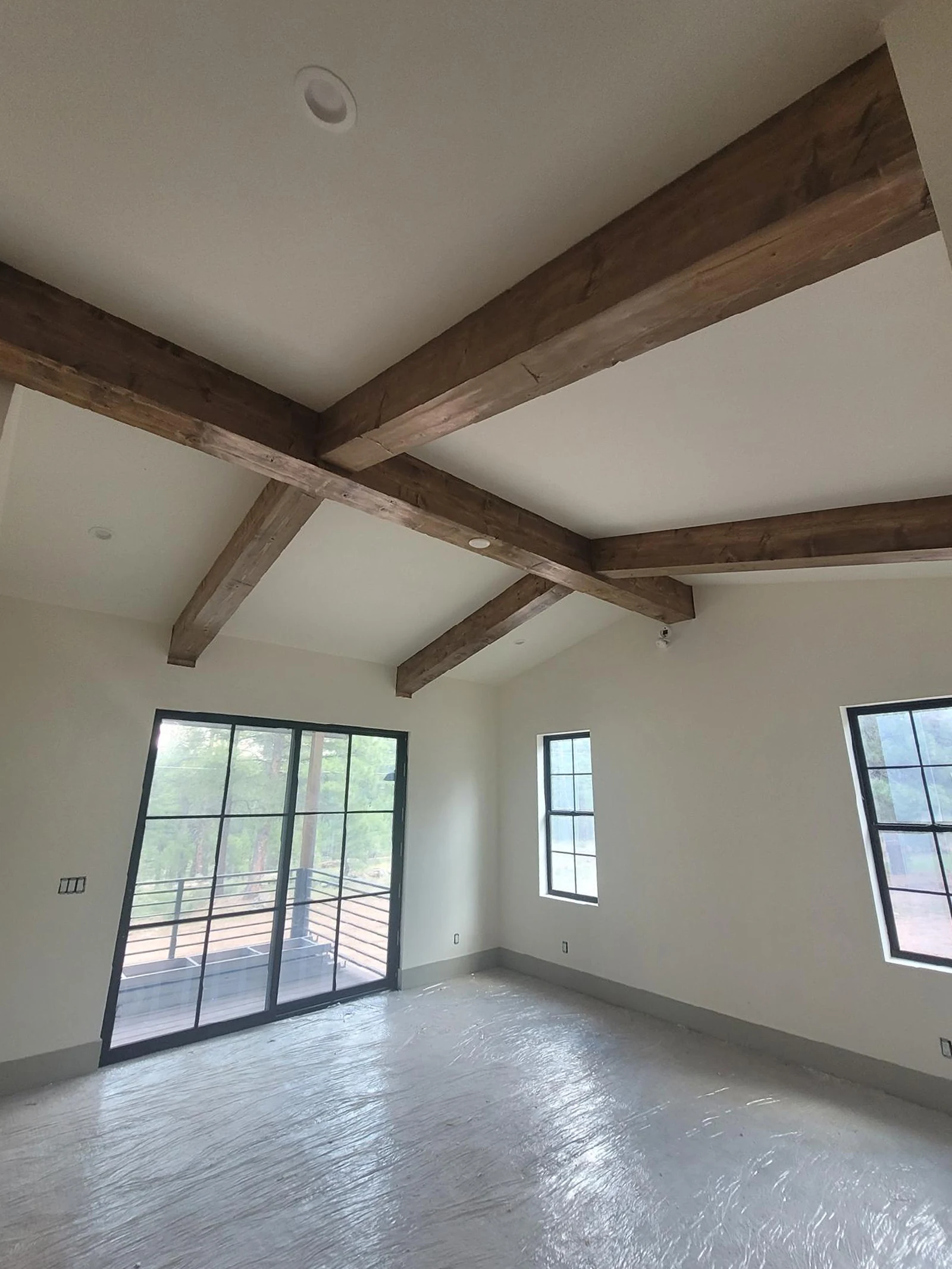
The two most common ceiling-beam finishes are hand-hewn and rough-sawn. They sound similar. They look nothing alike in a real room. Picking the wrong one is the fastest way to spend beam money and end up with a ceiling that feels off.
Here's the short version, then the details.
The short version
Hand-hewn beams have deep, irregular tool marks from an adze or broadaxe. They catch light and cast shadow. They read as old, weighty, and intentional. Choose them when the beam has to be the story of the room.
Rough-sawn beams have the straight, parallel saw marks left by a bandsaw or circular mill. They read as rustic but flat. They work as background texture, not as focal points. Choose them when you want warmth without drawing the eye.
How they look in an Arizona great room
Arizona great rooms are usually big, bright, and tall. Sunlight rakes across ceiling surfaces at low angles most of the day. Hand-hewn faces exploit that: every tool mark throws a small shadow, and the beam reads three-dimensional from across the room. In the same light, a rough-sawn beam reads as a stained plank on the ceiling.
If your room has vaulted or tray ceilings above ten feet, hand-hewn almost always wins. Below that, either can work, and rough-sawn's flatter profile can actually help a low ceiling feel less heavy.
Species and stain
Both finishes work in Ponderosa pine, Douglas fir, oak, and reclaimed timber. Pine is our default in Arizona: it hand-hews cleanly, holds stain evenly, and stays dimensionally stable in our low-humidity climate.
Stain reads differently on the two finishes. Hand-hewn faces catch stain in the tool-mark valleys and read darker in shadow, lighter on the peaks. Rough-sawn faces stain evenly and read as one flat tone. Bring floor and cabinetry samples to the stain review; the beam has to sit inside your existing wood package, not fight it.
Cost and lead time
Hand-hewing is manual work, so hand-hewn beams cost 20 to 40 percent more than rough-sawn equivalents in the same species and dimension. Lead times are similar: 2 to 3 weeks in-shop for either, plus one install day for a typical great-room package.
For a single box beam in a standard great room, plan $1,800 to $4,500 installed. For a full great-room package of three to five beams, plan $6,000 to $18,000. These are indicative ranges. Every project gets a written scope after a walk-through.
How to decide
Ask yourself one question: do you want people to notice the beams the moment they walk in, or do you want the beams to warm the room without commanding it? If the answer is notice, choose hand-hewn. If the answer is warm, choose rough-sawn.
Still not sure? Book a consult and we will bring samples of both to your ceiling. Fifteen minutes with real wood under your actual light is worth a week of research.
Related services in Arizona
Frequently asked
Can you mix hand-hewn and rough-sawn beams in the same house?
Yes, but not in the same room. Use hand-hewn in showcase rooms and rough-sawn as background in secondary spaces so each finish has a job.
Do rough-sawn beams age well in Arizona?
Yes. Kiln-dried and properly finished, rough-sawn beams are dimensionally stable in Arizona's dry climate and hold their tone for decades.
Are your hand-hewn beams solid or box construction?
Both. Box beams are lighter, easier to mount over existing framing, and identical from every sight line. Solid reads deepest and is the right choice for shorter spans where weight is not a concern.
Do you install hand-hewn beams outside the Phoenix metro?
Yes. We install across Arizona, including Sedona, Flagstaff, Prescott, Tucson, and the White Mountains.
Ready to plan a custom finish carpentry project in Arizona?
Request a Quote